
 English
 हिन्दी
 Melayu
 Español
 Français
 العربية
 Deutsch
 lingua italiana
 shqiptare
 日本語
日本語 Bahasa indonesia
 Nederlands
 Portugues
 한국어
한국어 Filipino
 Pусский
What is a plastic cuvette?
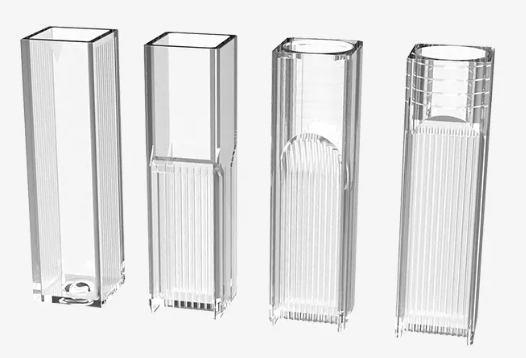
A plastic cuvette is a small, transparent, and disposable container used in laboratories for various purposes, primarily in spectrophotometry. Spectrophotometry is a technique used to measure the absorbance or transmittance of light by a substance at different wavelengths. Cuvettes are essential in this process as they hold the sample solution and allow light to pass through it, so its properties can be measured.
What is a quartz cuvette?
A quartz cuvette is a small, transparent container made of high-quality quartz glass used in scientific and analytical applications, particularly in spectrophotometry and other optical measurements. Unlike plastic or glass cuvettes, quartz cuvettes are valued for their exceptional optical properties, as well as their ability to withstand harsh chemical conditions and maintain high optical clarity.
What is a plastic cuvette used for?
Disposable plastic cuvettes are typically made from materials like polystyrene or acrylic and are used for a wide range of applications, plastic laboratory cuvettes are used in the visible range for colorimetric assays and the UV range for DNA, RNA, and protein analysis.
Absorbance and transmittance measurements: Lab cuvettes are used to hold the sample solution, allowing a spectrophotometer to measure how much light is absorbed or transmitted by the substance at specific wavelengths. This is common in chemical and biological analyses.
Fluorescence and luminescence measurements: Cuvettes can be used for studies involving fluorescence and luminescence, where a sample emits light after being exposed to a specific excitation wavelength.
Colorimetry: In colorimetry, the color of a solution or sample is determined by measuring the absorbance of light at different wavelengths using a spectrophotometer. Plastic cuvettes are often used in these experiments.
Chemical reactions: Cuvette lab can be employed to mix reagents and observe reactions in a controlled environment. Their optical transparency allows for real-time monitoring of reactions.
One significant advantage of plastic cuvettes is their disposability. Unlike quartz or glass cuvettes, which may require meticulous cleaning and can be expensive to replace, plastic cuvettes are affordable and can be used once and then discarded. This reduces the risk of contamination between samples and eliminates the need for extensive cleaning protocols, making them convenient for routine laboratory work.
What is a quartz cuvette used for?
Quartz cuvettes are chosen when the precision, optical transparency, and chemical resistance they offer are essential for the experiment or analysis being conducted.
Optical Clarity: Quartz is an excellent material for cuvettes because it has very low levels of impurities and a high degree of optical transparency in the ultraviolet (UV), visible, and near-infrared (NIR) spectrums. This makes it suitable for a wide range of analytical measurements and spectroscopy.
Chemical Resistance: Quartz cuvettes in laboratory are highly resistant to various chemicals, including strong acids, bases, and organic solvents. This makes them ideal for applications involving reactive or corrosive substances.
High Temperature Tolerance: Quartz can withstand high temperatures without deforming or becoming damaged, allowing for measurements in elevated-temperature environments.
UV and NIR Spectroscopy: Quartz cuvettes are commonly used in UV and NIR spectrophotometry, where precise measurements in these spectral ranges are critical. They are particularly well-suited for applications involving nucleic acid and protein quantification and analysis.
Precision and Reproducibility: The exceptional optical properties of quartz cuvettes contribute to high precision and reproducibility in spectroscopic measurements, making them preferred for research and quality control laboratories.
Longevity: While quartz cuvettes are more expensive than plastic or glass cuvettes, they have a longer lifespan if properly handled and maintained. They are less prone to scratching and damage during cleaning and usage.
Microvolume Measurements: Some quartz cuvettes are designed for microvolume measurements, which require only a tiny amount of sample solution. These cuvettes are particularly useful in DNA and RNA quantification and concentration measurements.
Plastic cuvettes and quartz cuvettes are two different types of sample containers used in scientific and analytical applications, particularly in spectrophotometry and other optical measurements. They differ in several key aspects:
Material:
Plastic Cuvette: Plastic lab cuvettes are typically made from materials like polystyrene or acrylic. They are inexpensive, disposable, and easy to replace. However, their optical properties may not be as precise as those of quartz cuvettes, and they are not suitable for use with certain chemicals and in applications that require high optical transparency.
Quartz Cuvette: Quartz cuvettes are made of high-quality quartz glass, which has exceptional optical properties and is highly transparent across a wide range of wavelengths, including UV, visible, and near-infrared. Quartz cuvettes are known for their superior optical clarity and precision.
Optical Transparency:
Plastic Cuvette: Plastic laboratory cuvettes have limited optical transparency and may not be suitable for applications requiring accurate measurements in the UV or NIR regions.
Quartz Cuvette: Quartz cuvettes offer excellent optical transparency, making them ideal for applications demanding high precision and accuracy, especially in the UV and NIR spectrums.
Chemical Resistance:
Plastic Cuvette: Plastic cuvettes are less chemically resistant compared to quartz cuvettes. They are not suitable for use with strong acids, bases, and certain organic solvents.
Quartz Cuvette: Quartz cuvettes are highly resistant to a wide range of chemicals, including strong acids, bases, and many organic solvents. This makes them suitable for applications involving corrosive or reactive substances.
Temperature Tolerance:
Plastic Cuvette: Plastic cuvettes have limited temperature tolerance and may not be suitable for high-temperature applications.
Quartz Cuvette: Quartz cuvettes can withstand high temperatures without deformation or damage, making them suitable for measurements in elevated-temperature environments.
Durability:
Plastic Cuvette: Plastic cuvettes are relatively fragile and can be easily scratched or damaged, which can affect measurement accuracy. They are also disposable and have a shorter lifespan.
Quartz Cuvette: Quartz cuvettes are more durable and less prone to damage. With proper handling and maintenance, they can have a longer lifespan.
Cost:
Plastic Cuvette: Plastic cuvettes are more affordable than quartz cuvettes, but they are typically disposable and need to be replaced after each use.
Quartz Cuvette: Quartz cuvettes are more expensive, but their longevity and superior optical properties can make them a cost-effective choice for applications that require high precision and chemical resistance.
Yongkang Medical is a leading manufacturer and supplier of plastic cuvette labs for scientific research and experimentation. We specialize in producing high-quality plastic cuvettes that meet the highest standards of accuracy, reliability, and durability. We offer a range of cuvette sizes to accommodate different sample volumes and experiment requirements. Our cuvettes are designed for easy handling and maintenance, and they are disposable. Contact us to buy plastic cuvette labs.


