
 English
 हिन्दी
 Melayu
 Español
 Français
 العربية
 Deutsch
 lingua italiana
 shqiptare
 日本語
日本語 Bahasa indonesia
 Nederlands
 Portugues
 한국어
한국어 Filipino
 Pусский
In laboratories, pharmaceutical production, and medical research settings, the purity of liquids—whether water, solvents, or biological solutions—is critical. One of the most trusted tools for achieving high-level filtration is the Millipore filter, a term commonly used to describe precision membrane filters designed for sterile, particle-free fluid processing. But how exactly does a Millipore filter work, and what makes it suitable for both aqueous and organic systems?
Core Principle: How a Membrane Filter Achieves Sterile Filtration
At the heart of every Millipore filter is a thin, porous membrane filter engineered to remove particles, microorganisms, and contaminants from liquids and gases. Unlike traditional depth filters that trap impurities throughout a thick matrix, membrane filters operate through a process called surface filtration, where particles larger than the pore size are retained on the surface while the purified fluid passes through.
These membranes are typically made from materials such as:
Mixed cellulose ester (MCE) – Ideal for general aqueous solutions and microbiological testing
Polyvinylidene fluoride (PVDF) – Chemically resistant, used in both water and organic systems
Polytetrafluoroethylene (PTFE) – Hydrophobic and solvent-resistant, perfect for aggressive organic solvents
Nylon – Offers high protein binding resistance and durability
Pore sizes range from 0.1 µm to 0.45 µm, with 0.22 µm being the standard for sterilizing filtration, as it effectively removes bacteria (which are typically 0.5 µm or larger).
The filtration process is driven by pressure—either from a vacuum, syringe, or pump—forcing the liquid through the membrane while retaining unwanted particulates and microbes.
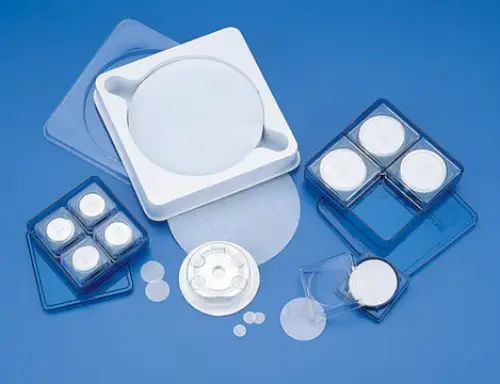
Water System Membrane Filter: Ensuring Purity in Aqueous Solutions
A water system membrane filter is specifically designed for filtering aqueous solutions such as buffer solutions, cell culture media, and laboratory-grade water (e.g., Type I or ultrapure water). These filters must be hydrophilic (water-attracting) to ensure even flow and prevent air locking.
Common applications include:
Sterilizing cell culture media without heat (which could denature proteins)
Preparing HPLC mobile phases
Filtering biological samples prior to analysis
Materials like MCE and hydrophilic PVDF are frequently used in water system membrane filters due to their compatibility with water-based solutions and low protein binding—ensuring that valuable biomolecules aren't lost during filtration.
It's important to note that not all membrane filters are suitable for water systems. Hydrophobic membranes (like untreated PTFE) repel water and require pre-wetting with alcohol, making them less ideal for routine aqueous filtration.
Organic System Membrane Filter: Handling Solvents and Chemicals
When dealing with non-aqueous liquids such as alcohols, acetone, hexane, or acetonitrile, a standard water-compatible filter won't suffice. This is where an organic system membrane filter becomes essential.
These filters are made from chemically resistant materials like:
PTFE (polytetrafluoroethylene) – Highly inert, handles strong acids, bases, and organic solvents
PVDF (polyvinylidene fluoride) – Resists a broad range of solvents and is often used in pharmaceutical processing
Nylon – Good for moderate organic solvents but not suitable for strong acids or phenols
An organic system membrane filter must maintain structural integrity under aggressive chemical exposure and should not leach extractables that could contaminate the filtrate. This is especially crucial in analytical chemistry and drug development, where even trace impurities can skew results.
For example, when preparing a solvent for GC-MS (gas chromatography-mass spectrometry), using a high purity Millipore filter organic system ensures that no membrane-derived compounds interfere with detection.
Millipore Filter Organic System: Specialized Design for Harsh Environments
The term Millipore filter organic system refers to a category of membrane filters optimized for use with organic solvents and aggressive chemicals. These are not just off-the-shelf filters but are engineered with specific pore uniformity, low extractable content, and high burst strength.
Key features include:
Hydrophobic or solvent-wettable surfaces – Prevent clogging and ensure consistent flow
Low binding properties – Minimize loss of active compounds in drug formulations
Autoclavable options – Some PVDF and PTFE filters can be sterilized via autoclaving for reuse in controlled environments
These filters are often housed in polypropylene or stainless-steel filter units designed to withstand high pressure and chemical exposure. They are commonly used in:
Pharmaceutical synthesis
Quality control labs
Environmental testing of organic pollutants
Manufacturers and suppliers, including those aligned with Yongkang Medical's quality standards, ensure that Millipore filter organic system products meet ISO 13485 and other regulatory benchmarks for performance and sterility.
How Pressure and Flow Rate Affect Millipore Filter Performance
The efficiency of a Millipore filter depends not only on the membrane material but also on the filtration setup. Two key variables are:
Transmembrane pressure (TMP) – The pressure difference across the membrane
Flow rate – The volume of liquid passing through per unit time
Too high a pressure can damage the membrane or force particles through the pores, compromising sterility. Too low, and the process becomes inefficient. Optimal pressure varies by membrane type:
MCE: 5–15 psi
PVDF: up to 50 psi
PTFE: up to 60 psi
Syringe filters are typically used for small volumes (<100 mL), while larger-scale applications use vacuum manifolds or inline filter housings.
Additionally, pre-filtration with a coarse filter can extend membrane life by removing large particulates before they reach the fine membrane.
Applications in Medical and Research Settings
Beyond chemistry labs, membrane filter systems are vital in medical device testing, vaccine production, and diagnostic reagent preparation. For instance:
Sterile filtration of injectable drugs ensures no microbial contamination
Removal of endotoxins using specialized ultrafiltration membranes
Clarification of protein solutions prior to chromatography
In these contexts, the reliability of a water system membrane filter or organic system membrane filter directly impacts patient safety and data accuracy. This is why institutions rely on trusted filtration standards—similar to those upheld by companies like Yongkang Medical—that prioritize consistency, traceability, and compliance.
Maintenance, Storage, and Shelf Life of Membrane Filters
To ensure optimal performance, proper storage is essential. Membrane filters should be:
Stored in a clean, dry environment
Kept away from direct sunlight and extreme temperatures
Used before the expiration date (typically 3–5 years from manufacture)
Once used, most membrane filters are single-use and must be disposed of as biohazard or chemical waste, depending on the filtrate.
Reusable filter housings should be cleaned and inspected regularly to prevent cross-contamination.
The Millipore Filter as a Pillar of Modern Filtration Technology
The Millipore filter is not just a brand name—it represents a class of high-precision membrane filter systems that have become indispensable in scientific and medical fields. Whether filtering water in a cell culture lab or processing organic solvents in pharmaceutical development, the right filter ensures purity, safety, and reproducibility.
Understanding the differences between water system membrane filter and organic system membrane filter, and knowing when to use a Millipore filter organic system, empowers researchers and medical professionals to make informed decisions. As technology advances, the principles of material compatibility, pore size accuracy, and system integrity—values reflected in the offerings of responsible suppliers like Yongkang Medical—remain central to achieving reliable filtration outcomes.
Yongkang Medical is a dependable manufacturer specializing in high quality organic system membrane filter. With extensive experience in designing and producing lab grade millipore filter organic system equipment, we offer dependable solutions customized to suit diverse laboratory needs. For more information or to place an order, feel free to reach out to us at: czyk001@163.com or eric@yongkangcn.com.


