
 English
 हिन्दी
 Melayu
 Español
 Français
 العربية
 Deutsch
 lingua italiana
 shqiptare
 日本語
日本語 Bahasa indonesia
 Nederlands
 Portugues
 한국어
한국어 Filipino
 Pусский
Terwijllaboratorium staatDeze ogenschijnlijk kleine hulpmiddelen kunnen in het laboratorium misschien bescheiden lijken, maar dragen aanzienlijk bij aan het gemak en de efficiëntie van uw dagelijkse werk. Ontdek de verschillende soorten laboratoriumstandaards en leer over hun optimale toepassingen in verschillende laboratoriumexperimenten.
Wat is een Lab Retort-standaard?
Alaboratorium retortstandaardis een stukje wetenschappelijke apparatuur dat veel wordt gebruikt in scheikunde- en biologielaboratoria. Het bestaat uit een verticale metalen staaf bevestigd aan een zware basis, die voor stabiliteit zorgt. De staaf heeft vaak een klem of andere bevestigingen aan de bovenkant, waardoor verschillende laboratoriumapparatuur veilig kan worden ondersteund.
Klemstandaard:
Een klemstandaard is een variant van de retortstandaard, gekenmerkt door een klem die aan een staafstandaard is bevestigd. Klemmen zijn alledaagse laboratoriumhulpmiddelen die zijn ontworpen voor het vastzetten van glaswerk en vaten, waaronder buretten, reageerbuizen, bekers en meer. Bepaalde soorten glaswerk zijn beter geschikt voor gebruik met klemstatieven, terwijl andere beter compatibel zijn met ringstatieven.
Ringstandaard:
Een ringstandaard functioneert vergelijkbaar met de klemstandaard en biedt ook ondersteuning voor laboratoriumglaswerk. Zoals de naam al aangeeft, bevat deze standaard een reeks ringen van verschillende grootte, ontworpen voor verschillende soorten laboratoriumglaswerk. Deze ringen zijn ideaal voor het bevestigen van bekers, kolven, kegels, trechters en andere apparatuur.
Jackstandaard:
Ook wel laboratoriumkrikken genoemd, bieden kriksteunen verticale ondersteuning voor laboratoriumgereedschap. Deze standaards lijken op een kleine lift en kunnen door technici worden aangepast om apparatuur op een specifieke hoogte te positioneren, waardoor gemakkelijke toegang tijdens experimenten wordt vergemakkelijkt. De meeste kriksteunen zijn voorzien van een knop voor eenvoudige hoogteverstelling, en veel zijn gemaakt van roestvrij staal om duurzaamheid te garanderen.
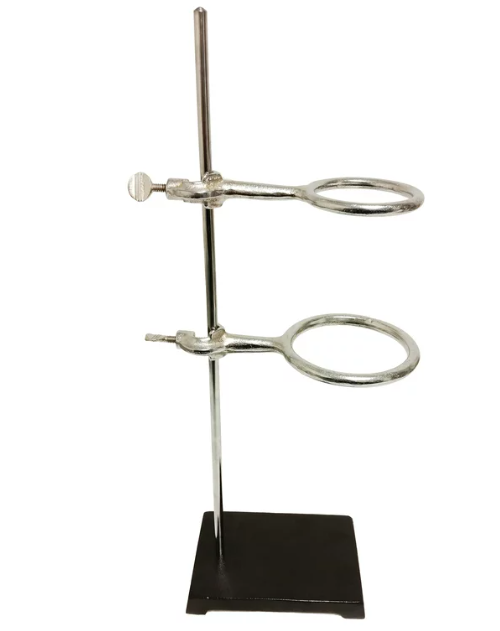
Ccomponenten van eenLabRetortStand
Verticale staaf:De verticale hoofdstang vormt het raamwerk voor de retortstandaard. Het is meestal gemaakt van metaal voor stabiliteit en duurzaamheid.
Baseren:De basis is een zware en stabiele fundering die voorkomt dat de retortstandaard omvalt. De basis kan een verzwaard ontwerp hebben of gemaakt zijn van een dicht materiaal zoals gietijzer.
Klem:Aan de bovenkant van de verticale staaf is een klem bevestigd die wordt gebruikt om laboratoriumglaswerk of andere apparatuur veilig op zijn plaats te houden. De klem heeft doorgaans een verstelbaar mechanisme om apparaten van verschillende afmetingen te kunnen huisvesten.
Baashoofd:De bosshead is een apparaat dat de klem aan de verticale stang bevestigt. Het maakt de rotatie en positionering van de klem mogelijk, wat flexibiliteit biedt bij het opzetten van laboratoriumapparatuur.
Toepassingen van Lab Retort-standaard
Nu u verschillende soorten laboratoriumstandaarden kent, vraagt u zich misschien af wat het doel is van een ringstandaard of ander gebruik van een standaard in een laboratorium.
Lab-antwoord staatzijn veelzijdige gereedschappen en worden vaak gebruikt ter ondersteuning van apparatuur zoals buretten, condensors en ander glaswerk tijdens chemische experimenten. Ze bieden een stabiel en verstelbaar platform voor verschillende laboratoriumopstellingen, wat bijdraagt aan de precisie en veiligheid van experimentele procedures.
Retortstandaard voor scheikunde vindens frequent application in chemistry laboratories, playing a pivotal role in various experiments and processes. They are integral in distillation experiments, particularly those involving organic distillations, providing a stable platform for the apparatus. In titrations, retort stands serve as essential supports for burettes, ensuring accurate and controlled delivery of reagents. Additionally, they are employed as reliable supports in filtration procedures within the laboratory setting.
Structure of Lab Retort Stand
Science retort stand typically features a cast iron base measuring approximately 200 x 125 mm. The rod, extending up to 750 mm, securely screws into a female thread within the base. This rod height is generally adequate for a wide range of experiments and is designed to fit conveniently within fume hoods and glove boxes. In instances where a taller rod is necessary, the solid base is often substituted with a tripod for enhanced stability, especially when supporting larger apparatuses such as significantly large tubes or bulk chemical bottles. The stand's height is adjustable by relocating the point of attachment for the provided clamp along the stand. The inclusion of a base serves to lower the center of gravity, thereby augmenting the overall stability of theiron support stand.
Benefits of Lab Retort Stand
Stability and Support:The retort stand provides a stable and secure platform for holding various laboratory apparatus, such as glassware, during experiments. This stability is essential to prevent accidents and ensure accurate results.
Versatility: Retort stands are versatile and can be used for a wide range of laboratory procedures, including distillation, titration, filtration, and more. They accommodate various attachments like clamps, bossheads, and rings, making them adaptable to different experimental setups.
Safety:The stability offered by retort stands enhances laboratory safety. It helps prevent glassware or equipment from tipping over, reducing the risk of breakage and chemical spills. This is especially important when working with hazardous substances.
Height Adjustment: The ability to adjust the height of the retort stand allows researchers to position equipment at the optimal level for their experiments. This customization is essential for achieving accurate and reliable results.
Compatibility with Fume Hoods and Glove Boxes:The height of the retort stand is typically designed to fit within fume hoods and glove boxes, ensuring that experiments can be conducted in controlled environments with proper ventilation.
Support for Larger Apparatus:In cases where taller setups or larger apparatus are required, retort stands can be replaced with tripods for added stability. This adaptability makes them suitable for a variety of experimental needs.
Facilitation of Laboratory Techniques: The retort stand plays a key role in supporting common laboratory techniques such as heating, mixing, and holding glassware in a fixed position during chemical reactions.
Time and Cost Efficiency: By providing a stable and adjustable support system, retort stands contribute to the efficiency of laboratory work. They help save time by facilitating quicker and more controlled setups, and they eliminate the need for constant adjustments or replacements during experiments.
Yongkang Medical is a leadingmedical gradechemistry retort stand supplier, we prioritize the quality, durability of their products. The companies may also offer customization options to meet the specific needs of their customers, including different sizes, shapes, and valve configurations. Contact us to orderchemistry retort stand.


