
 English
 हिन्दी
 Melayu
 Español
 Français
 العربية
 Deutsch
 lingua italiana
 shqiptare
 日本語
日本語 Bahasa indonesia
 Nederlands
 Portugues
 한국어
한국어 Filipino
 Pусский
While lab stands may appear unassuming in the laboratory, these seemingly small tools contribute significantly to the convenience and efficiency of your daily work. Explore the various types of lab stands and learn about their optimal applications in different laboratory experiments.
What is a Lab Retort Stand?
A laboratory retort stand is a piece of scientific equipment commonly used in chemistry and biology laboratories. It consists of a vertical metal rod attached to a heavy base, providing stability. The rod often has a clamp or other attachments at the top, allowing for the secure support of various lab apparatus.
Clamp Stand:
A clamp stand is a variant of the retort stand, characterized by a clamp affixed to a rod stand. Clamps are commonplace laboratory tools designed for securing glassware and vessels, including burettes, test tubes, beakers, and more. Certain types of glassware are better suited for use with clamp stands, while others are more compatible with ring stands.
Ring Stand:
Functioning similarly to the clamp stand, a ring stand also provides support for laboratory glassware. As the name implies, this stand incorporates a series of differently sized rings designed to accommodate various types of laboratory glassware. These rings prove ideal for securing beakers, flasks, cones, funnels, and other equipment.
Jack Stand:
Also referred to as laboratory jacks, jack stands offer vertical support for laboratory tools. Resembling a small lift, these stands can be adjusted by technicians to position equipment at a specific height, facilitating convenient access during experiments. Most jack stands feature a knob for straightforward height adjustment, and many are crafted from stainless steel to ensure durability.
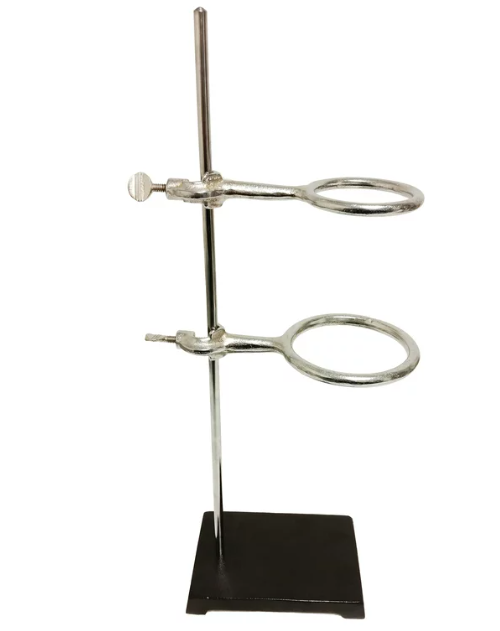
Components of a Lab Retort Stand
Vertical Rod: The main vertical rod provides the framework for the retort stand. It is usually made of metal for stability and durability.
Base: The base is a heavy and stable foundation that prevents the retort stand from tipping over. The base may have a weighted design or be made of a dense material like cast iron.
Clamp: A clamp is attached to the top of the vertical rod and is used to hold laboratory glassware or other equipment securely in place. The clamp typically has an adjustable mechanism to accommodate different sizes of apparatus.
Bosshead: The bosshead is a device that attaches the clamp to the vertical rod. It allows for the rotation and positioning of the clamp, providing flexibility in the setup of laboratory equipment.
Uses of Lab Retort Stand
Now that you know several types of lab stands, you may be wondering about the purpose of a ring stand or other stand uses in a laboratory.
Lab retort stands are versatile tools and are commonly used to support equipment such as burettes, condensers, and other glassware during chemical experiments. They provide a stable and adjustable platform for various laboratory setups, contributing to the precision and safety of experimental procedures.
Chemistry retort stand finds frequent application in chemistry laboratories, playing a pivotal role in various experiments and processes. They are integral in distillation experiments, particularly those involving organic distillations, providing a stable platform for the apparatus. In titrations, retort stands serve as essential supports for burettes, ensuring accurate and controlled delivery of reagents. Additionally, they are employed as reliable supports in filtration procedures within the laboratory setting.
Structure of Lab Retort Stand
Science retort stand typically features a cast iron base measuring approximately 200 x 125 mm. The rod, extending up to 750 mm, securely screws into a female thread within the base. This rod height is generally adequate for a wide range of experiments and is designed to fit conveniently within fume hoods and glove boxes. In instances where a taller rod is necessary, the solid base is often substituted with a tripod for enhanced stability, especially when supporting larger apparatuses such as significantly large tubes or bulk chemical bottles. The stand's height is adjustable by relocating the point of attachment for the provided clamp along the stand. The inclusion of a base serves to lower the center of gravity, thereby augmenting the overall stability of the iron support stand.
Benefits of Lab Retort Stand
Stability and Support: The retort stand provides a stable and secure platform for holding various laboratory apparatus, such as glassware, during experiments. This stability is essential to prevent accidents and ensure accurate results.
Versatility: Retort stands are versatile and can be used for a wide range of laboratory procedures, including distillation, titration, filtration, and more. They accommodate various attachments like clamps, bossheads, and rings, making them adaptable to different experimental setups.
Safety: The stability offered by retort stands enhances laboratory safety. It helps prevent glassware or equipment from tipping over, reducing the risk of breakage and chemical spills. This is especially important when working with hazardous substances.
Height Adjustment: The ability to adjust the height of the retort stand allows researchers to position equipment at the optimal level for their experiments. This customization is essential for achieving accurate and reliable results.
Compatibility with Fume Hoods and Glove Boxes: The height of the retort stand is typically designed to fit within fume hoods and glove boxes, ensuring that experiments can be conducted in controlled environments with proper ventilation.
Support for Larger Apparatus: In cases where taller setups or larger apparatus are required, retort stands can be replaced with tripods for added stability. This adaptability makes them suitable for a variety of experimental needs.
Facilitation of Laboratory Techniques: The retort stand plays a key role in supporting common laboratory techniques such as heating, mixing, and holding glassware in a fixed position during chemical reactions.
Time and Cost Efficiency: By providing a stable and adjustable support system, retort stands contribute to the efficiency of laboratory work. They help save time by facilitating quicker and more controlled setups, and they eliminate the need for constant adjustments or replacements during experiments.
Yongkang Medical is a leading medical grade chemistry retort stand supplier, we prioritize the quality, durability of their products. The companies may also offer customization options to meet the specific needs of their customers, including different sizes, shapes, and valve configurations. Contact us to order chemistry retort stand.


