
 English
 हिन्दी
 Melayu
 Español
 Français
 العربية
 Deutsch
 lingua italiana
 shqiptare
 日本語
日本語 Bahasa indonesia
 Nederlands
 Portugues
 한국어
한국어 Filipino
 Pусский
A butterfly needle, also called a venipuncture needle, scalp vein set or winged infusion set, is a medical device used to draw blood or administer intravenous (IV) therapy. It features a thin needle, two flexible "wings" for handling, a transparent flexible tube, and a connector.
Compared to straight needles, butterfly needles offer better precision, making them ideal for accessing difficult veins or in situations requiring careful placement. However, there are instances where other types of needles are more suitable.
This article will explore the uses of butterfly needles, along with their advantages and disadvantages.
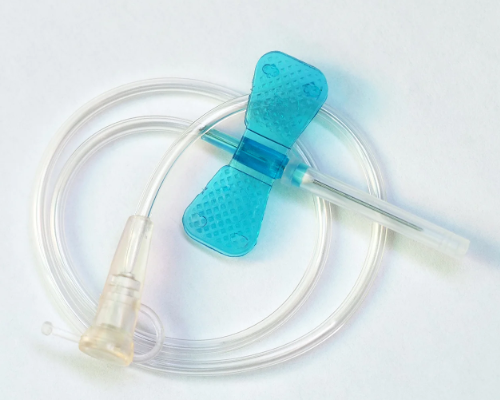
Uses of Butterfly Needles
Butterfly needles serve several temporary medical purposes, including:
Blood Draws
Phlebotomists often use butterfly needles to collect blood samples for various tests, as they allow for easier access to veins.
Hydration
Butterfly needles can be used to deliver IV fluids to patients who are dehydrated and unable to drink sufficient fluids. In some cases, such as with elderly patients or those in end-of-life care, they can be used subcutaneously (beneath the skin) for hydration.
Medication Delivery
These needles are also helpful for administering medications directly into the bloodstream, such as pain relief drugs, or for infusing IV therapies like chemotherapy or antibiotics.
Butterfly Needle vs. Huber Needle
Although similar in appearance with their winged design, a Huber needle is bent at a 90-degree angle and is used specifically for accessing implanted chemotherapy ports, unlike the straight butterfly needle.
Types of Butterfly Needles
While all butterfly needles share a similar design, they come in various sizes, measured by gauge. These gauges typically range from 18 to 27, with higher numbers indicating smaller needles. For example, a 27-gauge needle, commonly used for insulin injections, is thinner, while lower gauge needles are used for thicker fluids or blood transfusions. Most butterfly needles are around ¾ inch (19 millimeters) in length.
The tubing attached to the needle connects to either IV equipment or a blood collection container, reducing the risk of injury if the equipment is pulled or dropped. Tubing lengths vary from 8 to 15 inches (20 to 35 centimeters), with shorter tubes used for blood draws and longer ones for IV therapy. Some longer tubes feature roller valves to control the flow, and the tubes may be color-coded for easy identification when multiple lines are in use.
Butterfly needle connectors may come with built-in ports for vacuum tubes or ports compatible with syringes or IV lines.
While butterfly needles can remain in a vein for up to five to seven days when properly secured, they are generally used for short term infusions, unlike central lines or peripherally inserted central catheters (PICC lines) designed for long term treatments.
How Butterfly Needles Are Used
During venipuncture, which involves inserting a needle into a vein, a phlebotomist or nurse grips the butterfly needle by its wings with the thumb and index finger. This allows for precise placement of the needle, as the short length and close grip reduce the likelihood of the needle rolling or moving, unlike longer straight needles.
The needle is inserted into the vein at a shallow angle. When properly positioned, venous pressure will push a small amount of blood into the transparent tubing, confirming correct placement.
The wings of the needle also help stabilize it, preventing any rolling or shifting during the procedure.
After use, whether for blood draws or medication administration, the entire butterfly needle assembly is disposed of in a sharps container. The puncture site is then covered with a bandage.
Advantages
Butterfly needles offer several benefits due to their small size and shallow angle design. They are effective for accessing superficial veins close to the skin’s surface, causing less discomfort compared to larger intravenous catheters.
They are particularly useful for accessing small or narrow veins, such as those in infants, elderly individuals, or patients with rolling veins. However, they can pose a higher risk of needlestick injuries to healthcare providers compared to other needle types. Newer models feature a slide and lock sheath that automatically covers the needle as it is withdrawn to enhance safety.
Butterfly needles are well-suited for veins in challenging locations, such as the hand, foot, heel, or scalp, and are also beneficial for patients who are anxious about needles, as they are less intimidating and cause less risk of vein or nerve injury, especially when using a smaller gauge.
If you have small veins or have experienced difficulties with blood draws in the past, requesting a butterfly needle might be a more comfortable and effective option.
Disadvantages
Butterfly needles may not be suitable for all situations.
Due to their small size, blood collection can be slower, which can be an issue in urgent scenarios or at blood banks where quick processing is required. In such cases, choosing the appropriate needle size is crucial.
For routine blood draws, an incorrect needle size can lead to blockages, necessitating a second draw if a larger volume of blood is needed.
Additionally, since butterfly needles are left in place rather than using a catheter or PICC line for infusions, they can potentially damage a vein if the unit is accidentally pulled. Even with the correct needle size, improper placement can lead to blockages during treatment.
As a general guideline, butterfly needles are best used for IV infusions lasting five hours or less.
Conclusion
Butterfly needles are valuable for drawing blood or administering IV fluids, particularly for individuals with fragile veins, such as children, the elderly, or those who are anxious about needles. They can also be used subcutaneously in certain situations, like at home hydration for cancer patients or in long term care settings.
However, butterfly needles are not intended for long term use and should only be used for a few hours to a few days, depending on the need.
Consult with your healthcare team to determine if a butterfly needle is the best choice for your blood draw or other procedure.
Yongkang Medical is a leading manufacturer and supplier of high quality butterfly blood collection needles. We specialize in designing and producing innovative products that meet the needs of our customers and exceed their expectations. Good venipuncture needle and butterfly needles for sale! Just contact us: czyk001@163.com or eric@yongkangcn.com


