
 English
 हिन्दी
 Melayu
 Español
 Français
 العربية
 Deutsch
 lingua italiana
 shqiptare
 日本語
日本語 Bahasa indonesia
 Nederlands
 Portugues
 한국어
한국어 Filipino
 Pусский
Of course! Micropipettor is more accurate than a measuring cylinder. A micro pipettor is a dependable instrument designed for dispensing accurate volumes of liquid, enhancing the efficiency and precision of testing procedures.
What about Micropipettor?
A micropipette is a commonly employed laboratory tool designed for the precise measurement of small liquid volumes ranging from 1 to 1000µl. Its primary function involves the accurate transfer of fluids from one container to another.
Micropipettes find widespread application in microbiology, chemistry, medical, and soil testing laboratories, facilitating the meticulous handling of various liquid samples. Single-channel micropipettes are commonly utilized in research settings focused on molecular biology, microbiology, immunology, cell culture, analytical chemistry, biochemistry, and genetics. On the other hand, multichannel micropipettes are recommended for tasks such as ELISA (diagnostic tests), molecular screening, kinetic studies, and DNA amplification.
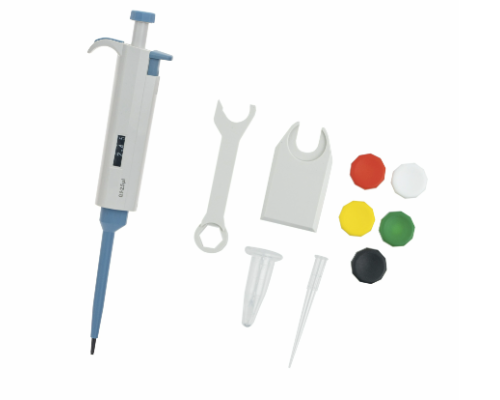
Components of a Micropipettor
Micropipettes come in various designs and sizes, but they share fundamental components. These essential parts include the plunger, digital display, tip cone, tip ejector, and grippy. Some micropipettes may also come with additional accessories like a calibration tool and a micropipette stand.
Plunger:
The plunger serves dual functions:
Volume Adjustment:
Rotate the plunger clockwise or anticlockwise to decrease or increase the volume setting. Each distinct click sound during volume adjustment ensures precise setting and helps prevent accidental changes.
Liquid Aspiration/Dispensing:
Press and depress the plunger to aspirate or dispense liquid.
Tip Ejector:
To avoid direct contact between the micro pipette's internal mechanism and the sample/liquid, disposable micropipette tips are utilized for drawing and dispensing liquid. Micropipettes feature a tip ejection system for the safe, effortless, and swift removal of tips. Tips can be easily ejected by pressing the tip ejector button.
Volume Display:
This component indicates the volume of liquid to be aspirated or dispensed.
Tip Cone:
The tip cone provides fitting for the tips. A micropipette with a universal tip cone is preferable as it enhances compatibility with most standard tips.
What Are the Applications of Micropipettor ?
Micropipettors find extensive applications in various fields, including:
Pharmaceuticals: Playing a crucial role in pharmaceutical experiments, micropipettes are utilized for sampling and analyzing active pharmaceutical ingredients (APIs), impurities, excipients, pharmaceutical solutions, and starting materials, including finished pharmaceutical products (FPP).
Health Care: Essential in healthcare divisions such as blood banks and pathology labs, micropipettes are employed to prepare blood and plasma samples for various testing purposes.
Food & Beverage: In the realms of research, production, and analysis & quality control, micropipettes are indispensable for testing food and related products, especially in Beverages & Drinking Water, Milk & Dairy Products, and Edible Fats & Oils.
Environmental Monitoring: Micropipettes contribute to different testing procedures related to soil, water, and pollution control in environmental monitoring.
Academic & Research Institutes: Providing easy lab access to students and researchers, micropipettes are utilized in various life sciences applications, including Cell and Tissue Culture, Microbiology, Biochemistry, Biology, Chemistry, and Stem Cell Research.
Diagnostic Kits: Micropipettes enhance diagnostic kits by offering a sophisticated blend of mobility and accuracy in pathogen detection, veterinary testing, meat speciation, fish speciation, GMO detection, allergen testing, and more.
Life Sciences: In molecular biology research and related experiments, micropipettes play a crucial role in DNA RNA Purification, PCR, RT PCR, Primers & Probes, Cloning, Proteomics, and Drug Discovery.
Types of Micropipettor:
Micropipettor can be categorized based on various factors:
Working Principle:
Air Displacement Micropipette:
Operating on the air displacement principle, this type utilizes a piston to aspirate and dispense liquid samples. The internal mechanism remains separated from the sample/liquid, and a disposable micropipette tip is employed for drawing and dispensing the liquid.
Positive Displacement Micropipette:
In this type, the piston directly contacts the sample. The disposable tip is a microsyringe with a capillary and a movable piston, which directly displaces the liquid.
Operating Mechanism:
Mechanical Micropipette:
Operated manually, these pipettes function based on a piston-shaft spring mechanism.
Electronic Micropipette:
Mostly automated, electronic micropipettes use one-touch buttons for aspirating and dispensing liquid, eliminating the need for manual plunger pressing. Some electronic pipettes allow users to create custom programs to suit diverse application needs.
Number of Channels:
Single Channel Micropipette:
Featuring a single channel, this micropipette is used to aspirate or dispense liquid.
Multi Channel Micropipette:
Equipped with multiple channels, such as 8-channel, 12-channel, or 16-channel variants, these micropipettes are employed to handle large volumes of samples, reducing the workload compared to single-channel micropipettes.
Volume/Capacity:
Fixed Volume Micropipette:
With a constant volume for aspiration and dispensing, these micropipettes are suitable for repetitive dispensing of the same volume.
Variable Volume Micropipette:
Featuring a specific minimum and maximum volume range, this micropipette allows users to adjust the volume of aspirated or dispensed liquid within the instrument’s range based on their requirements.
How Does a Micropipettor Work?
Air displacement micropipettes function through piston-driven air displacement. When the piston is pressed downward, the force expels air from the micropipette's sleeve, resulting in the removal of the liquid present in the tip.
Upon the piston's upward movement, a vacuum forms in the space previously occupied by the piston. This vacuum prompts the air from the tip to rise, filling the void, and the liquid is drawn up into the tip, replacing the air.
Positive displacement micropipettes operate through piston-driven displacement. The piston in a positive displacement micropipette is in direct contact with the liquid. When the piston is pressed downward, the liquid in the micropipette's sleeve also descends and is expelled through the tip. Conversely, when the piston is pulled upward, it draws the liquid along with it in an upward direction.
Why Is a Micropipettor More Accurate?
Firstly, micropipettes undergo accurate manufacturing processes to ensure the precise transfer and measurement of specific volume ranges. Secondly, their calibration precision is notably high, particularly in the case of manual pipetting. (Automatic pipettes, on the other hand, require regular calibration.)
In contrast, cylinders rely on subjective volume determination by visual inspection, typically based on the meniscus of the fluid. Even the smallest cylinder (excluding pipettes) lacks the precision of a genuine pipette when it comes to internal volume measurement.
Yongkang Medical is a company that specializes in the manufacturing and distribution of high quality science laboratory tool for medical applications. Contact us to order micro pipettor! We can supply single channel pipettor and 8 channel pipettor!


