
 English
 हिन्दी
 Melayu
 Español
 Français
 العربية
 Deutsch
 lingua italiana
 shqiptare
 日本語
日本語 Bahasa indonesia
 Nederlands
 Portugues
 한국어
한국어 Filipino
 Pусский
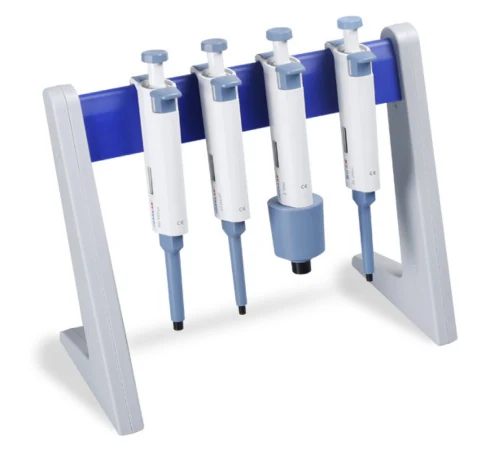
Pipettes need to be stored upright, so they need a pipette holder or pipette stand to prevent any residual liquid inside the instrument from running into the inner walls, which can cause corrosion. This pipette rack also ensures that the piston lubricant inside the pipette barrel remains evenly distributed.
10 Tips for Storing
Ensure temperature equilibrium: Ensure the pipette, tips, and liquids are at room temperature, if the experiment allows.
Maintain consistent pipette angle: Hold the pipette at a steady angle, not exceeding 20 degrees.
Aspirate properly: Immerse the tips just below the liquid’s surface (2-3 mm) when aspirating.
Touch off after dispensing: Touch off the pipette tip after each dispense before removing it from the target vessel.
Pre-wet the pipette tip: Aspirate and dispense the nominal volume three times to pre-wet the tip.
Optimize the volume range: Use the pipette within 35-100% of its nominal volume for best accuracy.
Discard first and last dispense: When dispensing multiple aliquots, discard the first and last dispense.
Handle viscous liquids: Pipette viscous liquids at slower speeds and use the "Reverse pipet" mode.
Handle volatile liquids: Pipette volatile liquids quickly and use the "Reverse pipet" mode.
Calibrate based on liquid density: Recalibrate the pipette if using a liquid with a significantly different density than water.
Before You Start
Ensure Temperature Equilibrium
To enhance accuracy and precision with an air displacement pipette, ensure the pipette, tips, and liquids are equilibrated to room temperature, if the experiment permits.
Accuracy refers to how closely the dispensed volume matches the set volume. It depends on pipette calibration and technique.
Precision indicates the consistency of the volume over multiple dispenses. It can be improved with correct pipetting practices.
Note: Temperature differences can cause the air cushion inside the pipette tip and pipette to contract or expand, which can adversely affect the accuracy and precision of the dispensed volume.
How to Pipette
Maintain Consistent Pipette Angle
When pipetting, maintaining a consistent angle is crucial for achieving accurate results. If possible, keep the pipette at a constant angle throughout the process, ideally not exceeding 20 degrees. For very small volumes of 30 microliters or less, it is best to hold the pipette as straight as possible.
Note: Changing the angle affects the hydrostatic pressure inside the tip, leading to inconsistent aspiration volumes.
How to Aspirate
A common mistake during aspiration is immersing the pipette tip too deeply in the source vessel. This increases the risk of liquid droplets clinging to the outside of the tip. To prevent this, immerse the tip just below the liquid's surface, ideally 2-3 mm, to aspirate the desired volume accurately. An exception is when aspirating extremely low volumes, such as 0.2 microliters.
Note: Liquid retained on the outside of the tip can lead to inaccurate dispensing.
Touch off after Dispense
After dispensing, you may notice a droplet at the tip end. To ensure accurate dispensing, use one of the following methods to remove the pipette from the target vessel:
Side Wall Touch Off:
Remove the pipette tip by sliding it along the sidewall of the vessel. This standard method is recommended for achieving precise dispenses.
Surface Touch Off:
Remove the tip by touching the liquid droplet on the surface of the liquid in the container. This technique is suitable for dispensing less than 1 microliter for a neat transfer. Touching the droplet to the liquid removes the small droplet from the pipette tip, ensuring accurate delivery.
Into Liquid Dispense:
If the dispense was directly into the liquid, it's considered a wet-dispense, and a touch-off is unnecessary. This method is ideal for small volume dispensing to prevent liquid from remaining on the vessel's side.
Note: Residual liquid often clings to the tip end after a dispense. The mentioned techniques effectively remove this residual liquid from the tip.
Optimizing Pipetting Performance
Pre-wet
After loading tips onto your pipette, aspirate and dispense the nominal volume three times. This process helps to equalize temperature differences and humidify the dead air space inside the pipette and tip. Neglecting this pre-wetting procedure can result in the initial dispenses delivering less volume due to evaporation.
Note: Evaporation can lead to droplet formation on the tip end as vapor pressure increases, forcing liquid out of the tip.
Optimize the Volume Range
The volume range of your pipette significantly influences both accuracy and precision. Air displacement pipettes demonstrate optimal performance when used between 35% and 100% of their nominal volume. The closer your dispense volume is to the total pipette volume, the more reliable your results will be. When operating below 35%, the dead air volume within the pipette increases substantially, raising the likelihood of inaccurate and imprecise dispensing. Moreover, working within the recommended volume range minimizes reliance on technique and diminishes user-related errors.
Discard First and Last Dispense
When utilizing the repeat dispense mode of an electronic pipette, it is advisable to exclude the first and last aliquots of the series. Here's the rationale behind this recommendation:
Mechanical Transition: Upon completion of liquid aspiration, the internal mechanisms of the pipette require a directional change before initiating dispensing. This transition may lead to the initial dispense containing a lower volume than intended.
Accuracy Variation: No pipette achieves 100% accuracy, meaning each dispense may deviate slightly from the target volume. Consequently, the last dispense accumulates the errors from all preceding dispenses.
Note: Owing to these factors, the first and last dispenses are prone to containing the most significant errors and should be omitted from the assay.
Viscous Liquids
Pipetting viscous samples presents unique challenges due to their slow uptake into the tip and tendency to adhere to the tip wall during dispensing, owing to their low elasticity. To address these challenges effectively, consider the following techniques:
Adjust Speed: Aspirate and dispense viscous samples at slower speeds. Additionally, pausing briefly after each aspiration or dispense allows the liquid more time to smoothly enter or exit the tip.
Utilize "Reverse Pipet" Mode: To mitigate the risk of dispensing volumes that are too low due to liquid adhering to the tip's inside wall, employ the "Reverse pipet" mode. This mode aspirates the desired volume plus an additional dispense that will be discarded, compensating for any retained liquid. An added advantage of reverse pipetting is the absence of blow-out at the end, preventing viscous liquids from foaming or forming air bubbles.
Volatile Liquids
Pipetting volatile liquids accurately can pose challenges due to their rapid evaporation compared to aqueous solutions, often leading to dripping tips. To prevent this issue, follow these steps:
Pre-wet Pipette Tips: Humidify the dead air space by pre-wetting the pipette tip. This involves aspirating and dispensing the full volume of your tip three times using the liquid you will be pipetting.
Utilize "Reverse Pipet" Mode: When pipetting volatile solutions, employ the "Reverse pipet" mode. This mode incorporates a larger sample volume, minimizing the impact of evaporation on the actual volume to be delivered. Additionally, pipette volatile liquids quickly to further reduce evaporation during the pipetting process.
Calibrate Based on Liquid Density
Substantial inaccuracies may arise when pipetting liquids diverging from aqueous solutions. It's imperative to recalibrate your pipette when the liquid significantly differs in density from water.
Note: Pipettes undergo testing and calibration at the factory using distilled water at room temperature. Pipetting liquids with varying densities can lead to inaccurate dispenses due to this calibration mismatch.
Yongkang Medical is an experienced company that specializes in the manufacturing and distribution of high quality pipette holder stand. Contact us to order pipette rack holder! Emails: czyk001@163.com or eric@yongkangcn.com


