
 English
 हिन्दी
 Melayu
 Español
 Français
 العربية
 Deutsch
 lingua italiana
 shqiptare
 日本語
日本語 Bahasa indonesia
 Nederlands
 Portugues
 한국어
한국어 Filipino
 Pусский
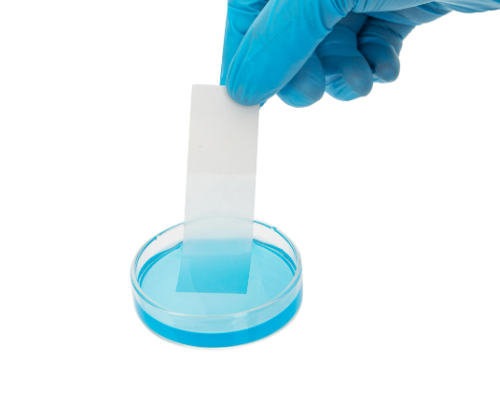
Absorbent paper, also known as blotting paper, is a specialized type of paper that is designed to absorb liquids, oils, and other fluids quickly and efficiently. It is made of a blend of cellulose fibers that are processed to produce a porous material with high absorbency. The absorbent paper is commonly used in laboratory and medical settings for applications such as drying and preserving samples, cleaning surfaces, and absorbing excess liquids. It is also used in the cosmetics industry for removing excess oil and moisture from the skin.
Absorbent grade paper is a highly specialized product, characterized by key properties such as high water absorbency, castor oil penetration (COP), and porosity. The water absorbency of the paper is influenced by the capillary radius within the paper structure. Similarly, COP is determined by the extent of pulp beating and the degree of collapse in the paper structure during sheet pressing. Incorporating a 4% NaHCO₃ solution in the manufacturing process enhances all three of these essential properties while also reducing the production cost by $4.07 per metric ton. The addition of NaHCO₃ in tap water increases surface tension forces, causing fibers to draw closer together during sheet formation.
Introduction
The rising costs of pulpable wood, energy, non-fibrous additives, and labor in the paper industry are inevitably reducing profit margins. To counteract this, there are two primary strategies to improve profitability: (a) producing value-added papers instead of commodity grades, and (b) altering the manufacturing process through in-house research and development without compromising the quality of the final product. Absorbent paper, typically made from kraft fiber, is known for its hydrophilic nature, porous structure, and high water absorption capacity. Key properties for absorbent-grade paper include water absorbency, maximum unbound fiber surface area, oil absorbency (measured by castor oil penetration, or COP), porosity, bulk, and wet strength (Dutt et al. 2003a). Water absorbency in paper is influenced by the length and diameter of capillaries, while COP is affected by the degree of pulp beating. Enhancing these basic properties can transform absorbent-grade papers into specialty papers, such as those with distinct top and bottom sides for padding paper (Dutt et al. 2003b), thin copper film layers for pictorial circuit boards (Dutt et al. 2003c), toxicity testing in seed germination paper (Dutt et al. 2005a), pore size and filtration rate in automotive and industrial filter paper (Dutt et al. 2005b), and resistance to flow, filtration efficiency, and dust-holding capacity in beer, coffee, beverage, and tea bag filter paper (Dutt et al. 2007). This study focuses on improving three fundamental properties of absorbent-grade paper—water absorbency (Klemm test), COP, and porosity—by increasing the surface tension of water with NaHCO₃, while also examining the impact on the cost of producing absorbent grade paper.
Experimental
Raw Materials
Screened chips of veneer waste from poplar and eucalyptus (mixed in an 80:20 ratio) were processed using a batch digester with an 85 m³ capacity. The digestion conditions included 20.0% active alkali (as Na₂O), 20% sulphidity, a bath ratio of 1:2.8, a maximum cooking temperature of 162°C, a time-to-temperature of 120 minutes, and a holding time at maximum temperature of 90 minutes. After cooking, the material was passed through a knotter screen and washed using Dorr-Oliver brown stock washers. The resulting pulp was bleached using the CEopHH bleaching sequence, achieving a viscosity of 9.2 cps and brightness of 84% (ISO). Additionally, softwood pulp with a brightness of 88% (ISO) was sourced from Star Paper Mills Ltd., Saharanpur, India.
Surface Tension Determination
Surface tension values were measured for tap water (with a hardness of 340 ppm), double-distilled water, and NaHCO₃ solutions in both tap and double-distilled water at varying concentrations, all at a temperature of 30°C. Dissolution of NaHCO₃ reached saturation at concentrations of 4% in tap water and 6% in double-distilled water. Surface tension comparisons with the pure liquid were conducted using a stalagmometer with a 2.5 mL capacity, which operates on the drop weight principle. A fixed volume of the liquid was allowed to flow through the capillary, and the number of drops was counted. Given the known densities of the liquids, the drop counts, weight, and surface tensions were compared (Chichkanov 2002).

In this equation, γ₁ and γ₂ represent the surface tensions of distilled water (72.5 dyne/cm) and sodium bicarbonate solution (90.5 dyne/cm), respectively. ρ₁ (1.01 g/cm³ for distilled water) and ρ₂ (1.0117 g/cm³) are the densities, while n₁ and n₂ are the respective number of drops for water and the NaHCO₃ solution.
Pulp Beating, Blending, and Stock Preparation
Both the mixed hardwood and softwood pulps were beaten using the Valley beater method (TAPPI T 200 sp 01 "Laboratory beating of pulp [Valley beater method]") under two conditions: (a) at various beating levels and (b) at a fixed °SR (30±1). The Valley beater maintained a consistency of 1.57%, using a 4% NaHCO₃ solution. Hardwood and softwood pulps were blended in different ratios by oven-dry weight, and a pulp suspension with 0.8% consistency was prepared for each blend. To enhance crosslinking, 1% melamine formaldehyde was added (Geobel et al. 1997), along with 0.1% sodium hexametaphosphate for uniform mixing of non-fibrous additives (Kleeman et al. 2003). Non-ferric alum (Al₂(SO₄)₃ 14-18 H₂O) was also added to maintain a pH of 6.5 and to enhance the interaction between the melamine formaldehyde resin and the fibers.
Laboratory handsheets (80 g/m²) were produced using a British sheet former (TAPPI T205 sp-02 "Forming handsheets for physical tests of pulp") with 4% NaHCO₃ solution. Backwater was collected and reused during the sheet-forming process by mixing it with fresh 4% NaHCO₃ solution in a 1:1 ratio for subsequent sheets. The handsheets were conditioned at a relative humidity of 65±2% and a temperature of 27±1ºC (TAPPI T 402 sp-03 "Standard conditioning and testing atmospheres for paper, board, pulp handsheets and related products") and then tested for wet strength (TAPPI T 456 om-03 "Wet tensile breaking strength of paper and paperboard [Wet tensile strength]"), castor oil penetration (COP) (TAPPI T 462 om-01 "Castor-oil penetration test for Paper"), water absorbency via the Klemm test (TAPPI T 492 pm-76 "Water absorption of paperboard [Non-Bibulous]", see also ASTM D3285) (TAPPI Test Methods 2007), and porosity (IS: 9894-1981 "Method of test for smoothness/roughness of paper") (BIS 1997).
Yongkang Medical is a leading manufacturer and supplier of high quality blotting paper for laboratory, industrial, and food preparation applications. We specialize in designing and producing innovative products that meet the needs of our customers and exceed their expectations. Get good absorbent paper price, just contact us: czyk001@163.com or eric@yongkangcn.com


